

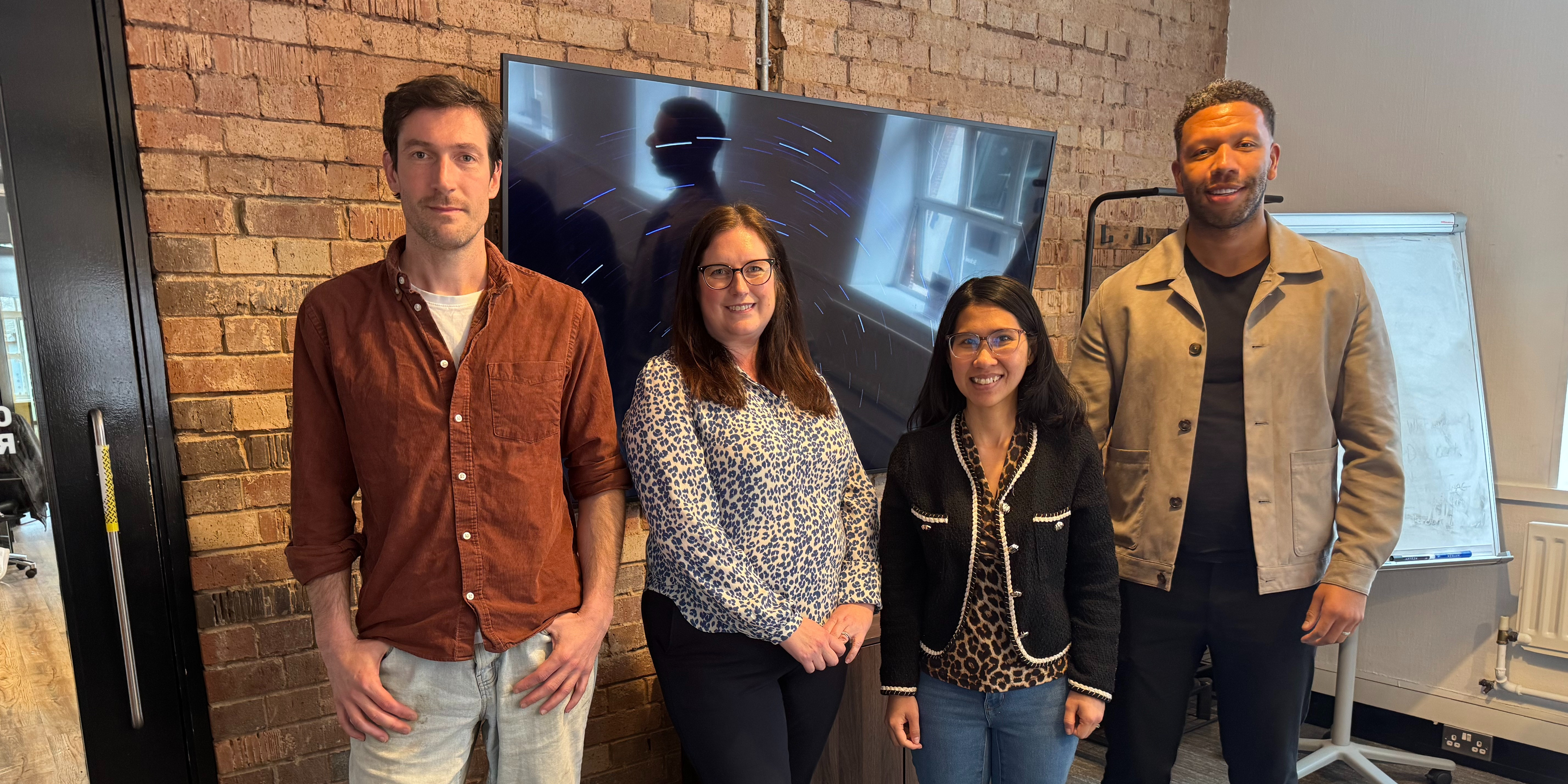
Different journeys, shared success: celebrating three Cooper Project graduates
At a recent Cooper Project graduation event at Sheffield Technology Parks, three founders stood up to share what it takes to turn an idea into an income-generating business.
Their ventures tackle different problems in entirely different markets: an AI concierge service for dental practices, an automated content platform for small businesses, and an EdTech tool transforming lesson planning for teachers. Their backgrounds varied too - from first-time founder to experienced tech entrepreneur, and a self-taught developer with NHS leadership experience.
But the common thread uniting them was that each founder benefitted from the space, support and environment to experiment, validate their ideas and build sustainable businesses on their own terms.
The Cooper Project exists to support founders at different stages of their journey, with different needs, ambitions and expertise. The stories shared at this packed-out graduation event - attended by a full cohort of current Coopers - reminded us why this matters.
Building businesses by solving real problems
For founder of Pulse AI Lee Duncan, his journey began with a simple question: where could AI genuinely solve a business problem?
After speaking to contacts and researching the market he identified a challenge facing private dental practices - they were overwhelmed with enquiries and often unable to respond quickly enough to potential patients.
That insight led him to develop an AI concierge service for dental practices, helping clinics manage and convert enquiries more effectively.
Lee explained that one of his biggest lessons on the Cooper Project was realising that traditional startup sales tactics were not the right fit for his business.
Instead of cold-selling, he invested heavily in market research - calling practices not to pitch, but to understand their inefficiencies. For several months, Lee was making 100 phone calls every day in order to reach as many dental practices as possible. Those conversations - and the commitment this required - helped him refine his positioning, develop use cases and build case studies from early adopters. Through targeted Meta advertising, inbound enquiries soon followed, which have resulted in much warmer prospects. Lee commented:
“It flips the power balance when the customer comes to you, you aren’t going to get challenged or negotiated down on price for a service they are actively approaching you for.”
Reflecting on his experience on the Cooper Project, he highlighted the importance of environment and community:
“I had no real stability when I was just working from coffee shops, but being here surrounded by other founders, in a professional environment - that gave me stability and structure.”
Lee’s presence at STP even led to his first hire after a chance conversation while buying lunch locally; proof, he says, that opportunities often come from simply talking to people and being open to trying things.
His advice to other founders was simple:
“Go all in. Don’t look back and regret what you could have done or tried, but didn’t.”
Creating founder journeys that fit real life
For Kristina Rutherford, founder of 3Me, the journey has been as much about personal growth as product development.
Coming from a corporate NHS leadership background and working as a marketing consultant, Kristina identified a common challenge facing small business owners: generating demand through good, relevant content was working — but maintaining that momentum was becoming impossible once businesses became busy delivering services.
What began as a consultancy service evolved into an AI-powered platform designed to help businesses create consistent, on-brand evergreen content at scale.
The journey from no-code prototype to fully coded platform involved significant learning and adaptation.
“The tech I’m using has completely changed, and so has my knowledge,” Kristina shared. But that steep learning curve became a source of confidence. “I know my app inside out and I’m proud of that. If I had to rebuild it tomorrow, I could.”
Kristina also spoke openly about set setbacks and learning to define success on her own terms, and in line with her values.
“Momentum is key - don’t get in your own way by second guessing yourself all the time and don’t always do what you’re told you ‘should’ do. Life as a tech founder doesn’t have to be a certain way, it has to fit your lifestyle.”
As a mum of two young children, flexibility and freedom have become central to how she builds her business. “I’m setting an example for my children about securing for yourself more freedom and prioritising your values. Doing this has allowed me to be present for the important things and spend more time with my family.”
The Cooper Project, she says, helped give her both clarity and confidence around funding, growth and decision-making.
“I’m really clear on what I want regarding investment and when I want it, and that’s something I’ve learned from being on the Cooper Project.”
For Kristina, community proved equally important:
“The community - being inspired by other founders’ success and sharing momentum - was the most valuable takeaway for me.”
Reflecting on Kristina’s progress, Rose Tran, STP’s Incubator Manager, said:
“I’m proud to see how much progress Kristina has made through the Cooper Project. Balancing this alongside mum-life, experiencing some setbacks, rapid changes in technology and learning brand new skills — she has come so far.”
Learn, build, test… and repeat
Unlike many early-stage founders, Mark Hughes arrived on the Cooper Project with significant startup experience already behind him, having previously launched and exited EdTech company Tutorful.
But with his new venture, Chalkie, things are already looking quite different - just over a year in. Mark set out with two things clear in his mind: he felt comfortable and passionate about EdTech, and he wanted to build something with AI. But, he didn’t know what problem he needed to solve.
He had already tried out a few new ideas but these ultimately failed due to lack of adoption - and not fully understanding his market. Applying the ‘fail fast’ mentality, Mark was able to figure out what had gone wrong and use this to put him in better stead for the next venture.
So, he spoke to around 30 teachers to understand their frustrations and where they were losing time. The answer quickly became clear: lesson planning.
As AI technology rapidly improved, Mark and his first co-founder, Pete, saw an opportunity to help teachers generate high-quality teaching resources faster and more efficiently. So, they moved fast to make it happen.
“In those first few months, we just kept going - we spoke to users, coded, designed, spoke to more customers… that’s all we did.”
After bringing in a third co-founder with complementary skills, Chalkie scaled rapidly. Today, the platform is already operating in 13 languages, has secured £3 million in investment and is generating £5 million in annual recurring revenue.
Even with that growth, Mark remains conscious of how quickly technology is evolving.
“Look, we were the right thing at the right time. But, am I worried that the speed AI is moving, we might not be needed in the future? When things like ChatGPT and Claude are so good? Absolutely. For the time being, we need to push this as hard and as far as it will go.”
Reflecting on his experience within the Cooper Project, Mark highlighted the value of challenge and accountability.
“It was my conversations with Rose. She was so good at challenging me and really pushing me on certain points. Things like sales - the bits I didn’t feel so comfortable with. She gave me things to think about.”
His advice to founders is not to wait for perfection before going to market: “Do things really quickly; build, get in front of people, see what works.”
A place to experiment, validate and grow
Through hearing these three founders’ journeys to becoming income-generating startups, one theme emerged: there is no single route to building a successful startup, and what works for some, won’t work for all.
Some founders need structure and stability to keep them on track. Others need challenge and peer-support. Some arrive with technical expertise, while others develop those skills during the process. Some are balancing family life, full-time jobs or other commitments, while others are scaling fast-moving ventures into global markets.
That diversity is exactly what the Cooper Project and Sheffield Technology Parks are designed to support. Reflecting on the graduation event, Rose said:
“What was interesting about the event was to hear how all three graduating founders really benefitted from different aspects of the Cooper Project and what we offer on a wider scale at Sheffield Technology Parks: environment and space, support and accountability, connections and community.”
She added:
“People need different things at different times on their journey, but our experience enables us to curate the essential ingredients for innovation to thrive and to deliver them in a flexible and bespoke way.”
As the next cohort of Cooper founders listened, asked questions and no doubt considered their next steps, there was a definite feeling that Sheffield Technology Parks is a place where they have the freedom, support and infrastructure to experiment, evolve and build businesses in ways that work for them.
News / Podcasts / Events